Indian Missile Systems Explained: Agni, BrahMos, Akash, S-400 — Types & Range
Types, range and capabilities of India's missile arsenal — filter, compare and understand how each system works.
Updated 24 Oct 2026 · By Defence Pulse – भारतीय रक्षा समाचार और ताज़ा खबरें DeskCompare India's Missiles by Range
Agni-VBallistic 5,000+ km
India's longest-range land-based missile. A test with multiple independently targetable re-entry vehicles (MIRV) was carried out under Mission Divyastra in March 2024.
- Propulsion
- Three-stage solid, canisterised
- Launch platform
- Road-mobile canister
- Developer
- DRDO
- Status
- In service
Agni-IVBallistic ~4,000 km
Intermediate-range ballistic missile with composite rocket motors and a ring-laser gyro navigation system.
- Propulsion
- Two-stage solid
- Launch platform
- Road-mobile
- Developer
- DRDO
- Status
- In service
Agni-IIIBallistic 3,000–3,500 km
Heavier two-stage missile that extended India's deterrence range beyond 3,000 km.
- Propulsion
- Two-stage solid
- Launch platform
- Rail / road-mobile
- Developer
- DRDO
- Status
- In service
Agni-IIBallistic 2,000+ km
Medium-range ballistic missile operated by the Strategic Forces Command.
- Propulsion
- Two-stage solid
- Launch platform
- Rail / road-mobile
- Developer
- DRDO
- Status
- In service
Agni-PrimeBallistic 1,000–2,000 km
New-generation, lighter Agni with canister launch; tested from a rail-based mobile launcher in 2025.
- Propulsion
- Two-stage solid, canisterised
- Launch platform
- Road and rail-based mobile launcher
- Developer
- DRDO
- Status
- Being inducted
Agni-IBallistic 700–1,200 km
The first member of the Agni family to enter service.
- Propulsion
- Single-stage solid
- Launch platform
- Rail / road-mobile
- Developer
- DRDO
- Status
- In service
ShauryaBallistic ~700 km
Hypersonic surface-to-surface missile derived from the submarine-launched K-15.
- Propulsion
- Two-stage solid, canisterised
- Launch platform
- Land-based canister
- Developer
- DRDO
- Status
- Developed
PralayBallistic 150–500 km
Conventional quasi-ballistic missile that can change its trajectory in flight, making interception harder.
- Propulsion
- Solid, quasi-ballistic
- Launch platform
- Road-mobile
- Developer
- DRDO
- Status
- Being inducted
Prithvi-IIBallistic ~350 km
One of the first missiles of the Integrated Guided Missile Development Programme (IGMDP).
- Propulsion
- Single-stage liquid
- Launch platform
- Road-mobile
- Developer
- DRDO
- Status
- In service
BrahMosCruise 290–450+ km
Supersonic cruise missile flying at about Mach 2.8, used by all three services. Extended-range versions exceed the original 290 km.
- Propulsion
- Solid booster + liquid ramjet
- Launch platform
- Land, ship, submarine, Su-30MKI
- Developer
- BrahMos Aerospace (India–Russia)
- Status
- In service
Nirbhay / ITCMCruise ~1,000 km
Subsonic long-range cruise missile; the Indigenous Technology Cruise Missile (ITCM) version uses an Indian-developed turbofan engine.
- Propulsion
- Solid booster + turbofan
- Launch platform
- Land-based
- Developer
- DRDO
- Status
- Under trials
K-4Submarine-launched ~3,500 km
Submarine-launched ballistic missile that gives India a sea-based nuclear deterrent.
- Propulsion
- Two-stage solid
- Launch platform
- Arihant-class SSBN
- Developer
- DRDO
- Status
- Being inducted
K-15 SagarikaSubmarine-launched ~750 km
India's first submarine-launched ballistic missile.
- Propulsion
- Two-stage solid
- Launch platform
- Arihant-class SSBN
- Developer
- DRDO
- Status
- In service
S-400 TriumfSurface-to-air Up to 400 km
Long-range air defence system inducted by the IAF from 2021, where it is known as Sudarshan Chakra.
- Propulsion
- Solid (multiple missile types)
- Launch platform
- Road-mobile batteries
- Developer
- Almaz-Antey, Russia
- Status
- In service
MRSAM (Barak-8)Surface-to-air ~70+ km
Medium-range surface-to-air missile used by the Navy, Air Force and Army.
- Propulsion
- Dual-pulse solid
- Launch platform
- Ships and land batteries
- Developer
- DRDO & IAI (India–Israel)
- Status
- In service
Akash-NGSurface-to-air ~70 km (reported)
Next-generation Akash with a canisterised launcher and an active radar seeker.
- Propulsion
- Dual-pulse solid
- Launch platform
- Road-mobile
- Developer
- DRDO
- Status
- Under trials
AkashSurface-to-air 25–30 km
Indigenous medium-range air defence missile in service with the Army and IAF, and exported abroad.
- Propulsion
- Integral rocket-ramjet
- Launch platform
- Road-mobile
- Developer
- DRDO / BDL
- Status
- In service
QRSAMSurface-to-air ~30 km
Quick Reaction Surface-to-Air Missile designed to protect moving Army columns.
- Propulsion
- Solid
- Launch platform
- Truck-mounted, on the move
- Developer
- DRDO
- Status
- Under trials
Rudram-1Air-to-surface ~100–150 km
Anti-radiation missile that homes on enemy radar emissions to destroy air defence networks.
- Propulsion
- Solid
- Launch platform
- Su-30MKI
- Developer
- DRDO
- Status
- Under trials
Astra Mk1Air-to-air ~100 km
India's first indigenous beyond-visual-range air-to-air missile.
- Propulsion
- Solid
- Launch platform
- Su-30MKI, Tejas
- Developer
- DRDO / BDL
- Status
- In service
Helina / DhruvastraAnti-tank ~7 km
Helicopter-launched version of the Nag anti-tank guided missile.
- Propulsion
- Solid
- Launch platform
- ALH Dhruv, LCH Prachand
- Developer
- DRDO
- Status
- Being inducted
Nag (NAMIS)Anti-tank ~4 km
Third-generation fire-and-forget anti-tank missile with an imaging infrared seeker.
- Propulsion
- Solid
- Launch platform
- NAMICA tracked carrier
- Developer
- DRDO / BDL
- Status
- In service
MPATGMAnti-tank ~2.5 km
Man-Portable Anti-Tank Guided Missile with top-attack capability for infantry.
- Propulsion
- Solid
- Launch platform
- Man-portable tripod
- Developer
- DRDO
- Status
- Under trials
Bar length uses a logarithmic scale so short-range and long-range systems can be compared on one chart. Click a missile for details. Ranges are approximate figures from official statements and open sources.
Head-to-Head Comparison
Full Table of Indian Missile Systems
| Missile | Type | Range (approx.) | Propulsion | Platform | Status |
|---|---|---|---|---|---|
| Agni-V | Ballistic | 5,000+ km | Three-stage solid, canisterised | Road-mobile canister | In service |
| Agni-IV | Ballistic | ~4,000 km | Two-stage solid | Road-mobile | In service |
| Agni-III | Ballistic | 3,000–3,500 km | Two-stage solid | Rail / road-mobile | In service |
| Agni-II | Ballistic | 2,000+ km | Two-stage solid | Rail / road-mobile | In service |
| Agni-Prime | Ballistic | 1,000–2,000 km | Two-stage solid, canisterised | Road and rail-based mobile launcher | Being inducted |
| Agni-I | Ballistic | 700–1,200 km | Single-stage solid | Rail / road-mobile | In service |
| Shaurya | Ballistic | ~700 km | Two-stage solid, canisterised | Land-based canister | Developed |
| Pralay | Ballistic | 150–500 km | Solid, quasi-ballistic | Road-mobile | Being inducted |
| Prithvi-II | Ballistic | ~350 km | Single-stage liquid | Road-mobile | In service |
| BrahMos | Cruise | 290–450+ km | Solid booster + liquid ramjet | Land, ship, submarine, Su-30MKI | In service |
| Nirbhay / ITCM | Cruise | ~1,000 km | Solid booster + turbofan | Land-based | Under trials |
| K-4 | Submarine-launched | ~3,500 km | Two-stage solid | Arihant-class SSBN | Being inducted |
| K-15 Sagarika | Submarine-launched | ~750 km | Two-stage solid | Arihant-class SSBN | In service |
| S-400 Triumf | Surface-to-air | Up to 400 km | Solid (multiple missile types) | Road-mobile batteries | In service |
| MRSAM (Barak-8) | Surface-to-air | ~70+ km | Dual-pulse solid | Ships and land batteries | In service |
| Akash-NG | Surface-to-air | ~70 km (reported) | Dual-pulse solid | Road-mobile | Under trials |
| Akash | Surface-to-air | 25–30 km | Integral rocket-ramjet | Road-mobile | In service |
| QRSAM | Surface-to-air | ~30 km | Solid | Truck-mounted, on the move | Under trials |
| Rudram-1 | Air-to-surface | ~100–150 km | Solid | Su-30MKI | Under trials |
| Astra Mk1 | Air-to-air | ~100 km | Solid | Su-30MKI, Tejas | In service |
| Helina / Dhruvastra | Anti-tank | ~7 km | Solid | ALH Dhruv, LCH Prachand | Being inducted |
| Nag (NAMIS) | Anti-tank | ~4 km | Solid | NAMICA tracked carrier | In service |
| MPATGM | Anti-tank | ~2.5 km | Solid | Man-portable tripod | Under trials |
Missile Types Explained
Ballistic missiles
A ballistic missile is powered by a rocket for the first part of its flight and then follows a high, arcing path, much like a thrown stone, before re-entering the atmosphere at very high speed. They are grouped by range: short-range (under 1,000 km), medium-range (1,000–3,000 km), intermediate-range (3,000–5,500 km) and intercontinental (over 5,500 km). India's Agni and Prithvi families are ballistic missiles.
Cruise missiles
A cruise missile flies like a small unmanned aircraft, using wings and an air-breathing engine to stay within the atmosphere, often at low altitude to avoid radar. They can be subsonic (Nirbhay) or supersonic (BrahMos), and are known for high accuracy.
Quasi-ballistic missiles
These follow a lower, flatter trajectory than a classic ballistic missile and can manoeuvre during flight, making them harder for missile defence systems to predict. Pralay is India's main example.
Surface-to-air missiles (SAM)
SAMs defend against aircraft, drones, cruise missiles and sometimes ballistic missiles. India uses a layered approach: short-range systems such as Akash and QRSAM, medium-range MRSAM, and long-range S-400.
Air-to-air and air-to-surface missiles
Fired from aircraft, air-to-air missiles such as Astra destroy enemy aircraft beyond visual range, while air-to-surface weapons such as Rudram-1 attack radar sites and ground targets.
Anti-tank guided missiles (ATGM)
ATGMs such as Nag, Helina and MPATGM are designed to defeat armoured vehicles. Many use "top-attack", striking the thinner armour on the roof of a tank.
How missiles are guided
- Inertial navigation: gyroscopes and accelerometers track position without outside signals — the backbone of most long-range missiles.
- Satellite navigation: GPS or India's NavIC updates improve accuracy.
- Radar seekers: active or semi-active radar homing guides SAMs and air-to-air missiles to moving targets.
- Infrared / imaging seekers: lock on to the heat or image of a target, as used by anti-tank missiles.
- Passive anti-radiation seekers: home on to enemy radar emissions.
Frequently Asked Questions
What is the longest-range missile of India?
Agni-V, with a range of more than 5,000 km, is India's longest-range land-based ballistic missile. In March 2024 it was tested with MIRV technology under Mission Divyastra.
What is the range of BrahMos?
The original BrahMos had a range of about 290 km. Extended-range versions in service can strike targets at around 450 km or more, flying at nearly Mach 2.8.
What is the difference between a ballistic and a cruise missile?
A ballistic missile is rocket-powered and follows a high arcing trajectory, while a cruise missile uses wings and an air-breathing engine to fly within the atmosphere, often at low altitude.
What is India's S-400 called?
The S-400 Triumf long-range air defence system is known as Sudarshan Chakra in the Indian Air Force. It can engage targets at ranges of up to about 400 km.
Which missile does India have on its submarines?
India's Arihant-class nuclear submarines carry the K-15 Sagarika (about 750 km) and the longer-range K-4 (about 3,500 km) submarine-launched ballistic missiles.
More Reader Tools
Latest Related Reports
 Military Satellite GSAT-7R की तैयारी तेज क्या भारतीय सेना की कम्युनिकेशन क्षमता अब और होगी मजबूत?
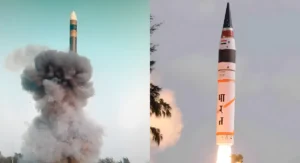 Agni-5 Missile ki Range, ताकत और टेक्नीक भारत की परमाणु शक्ति कितनी मजबूत है?
 114 Rafale Deal में बड़ा मोड़, क्या Astra और Rudram मिसाइलों को मिलेगा सीधा इंटीग्रेशन?
 Lokesh Machines को मिला Assam Rifles का बड़ा ऑर्डर, 1,013 ASMI Carbines की सप्लाई करेगी कंपनी